- Home
- Pest Guides
- Termite damage or wood rot? How to tell the difference
Termites & wood
Termite damage or wood rot? How to tell the difference
Soft, crumbling wood in a basement or crawl space is either a moisture problem, a termite problem, or both at once. The two look alike from a distance and very different up close, and telling them apart decides whether your first call goes to a plumber, a carpenter or us.
Call (217) 207-0945 Browse our services
- Written by Darlene Pemberton
- Updated October 1, 2026
- 7 minute read
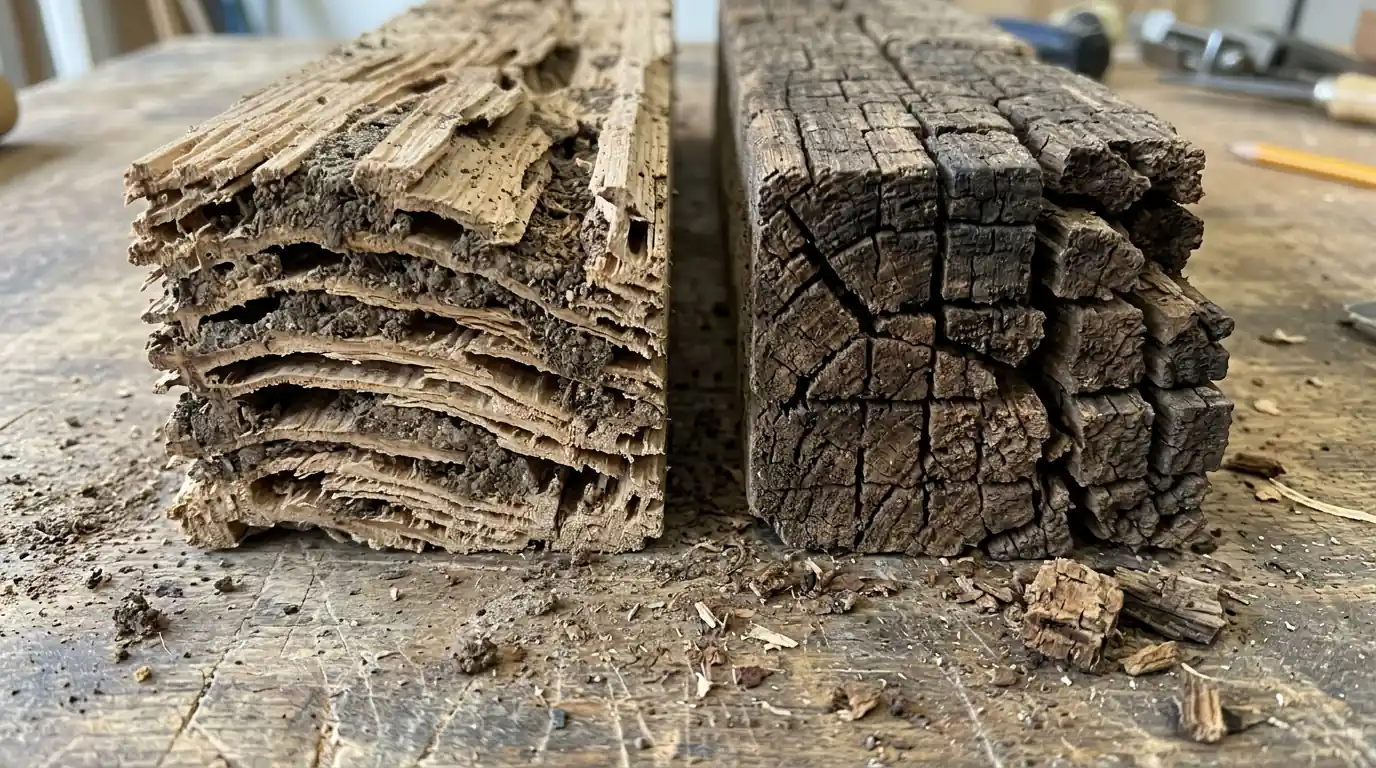
Termite damage follows the grain in hollowed, layered galleries with traces of soil or mud lining them, and the surface often looks intact until you probe it. Wood rot breaks the wood down across the grain into cracked cubes, stringy fibers or soft spongy patches, smells musty and always sits next to a moisture source. If you find soil inside the damage or mud tubes nearby, treat it as termites until an inspection says otherwise.
What subterranean termite damage looks like
Eastern subterranean termites, the species working the soil across the Metro East, eat the softer springwood between growth rings and leave the harder summerwood standing. Break open damaged wood and you see thin parallel layers, like pages in a swollen book, running with the grain. The galleries carry a lining of soil and dried excrement that looks like grainy mud, because these termites keep their tunnels humid by plastering them.
The outside often gives almost nothing away. Termites avoid open air, so a sill plate or trim board can look sound and painted while the interior is mostly hollow. A screwdriver pushed into the wood that sinks with little resistance, or a tap that sounds papery, is often the first real clue. Nearby, look for pencil-width mud tubes on foundation walls or piers; they are the commuting routes between the soil colony and the wood.
- Layered, onion-skin galleries running with the grain
- Grainy mud or soil packed into the tunnels
- Intact surface, hollow interior
- Mud tubes on nearby foundation walls or piers
- Shed wings on sills in spring
What wood rot looks like
Rot is fungal decay, and fungi need wood that stays wet, usually above roughly a fifth of its weight in moisture for long stretches. Brown rot, the most common type in houses, shrinks the wood and cracks it across the grain into rough cubes that crumble to powder between your fingers; it is what most people call dry rot even though it started wet. White rot leaves the wood pale, stringy and spongy. Soft rot works slowly on the surface of persistently damp lumber.
Every rot problem has an address for its water: a leaking tub drain, a sweating pipe, a downspout dumping at the foundation, a window sill catching rain, or a crawl space with no vapor barrier. Find the water and you have found the cause.
- Cracking across the grain into cubes
- Crumbling, powdery or stringy texture
- Musty smell, sometimes visible fungal growth
- Darkened or bleached wood
- Always beside a moisture source
When it is both
Termites love moist wood, so the two problems often share an address. A chronic plumbing leak softens a joist, and the softened, damp wood is exactly what foraging termites find first. That is why an inspection checks both: we probe for galleries and soil, and we note the moisture source in writing, because treating termites while the leak keeps going leaves the conditions that invited them.
A quick comparison
| Clue | Termites | Rot |
|---|---|---|
| Direction of damage | Along the grain, in layers | Across the grain, cubed or stringy |
| Inside the wood | Soil and mud lining | Fungal threads, powder, no soil |
| Surface | Often looks intact | Often visibly soft, stained or cracked |
| Nearby signs | Mud tubes, swarmer wings | Leaks, staining, musty smell |
| First call | Pest inspection | Find and fix the water |
What to do this week
Take photos of the damage, the surrounding wall and anything that looks like tubes. Do not tear into it further or spray anything on it; disturbing active termites makes them retreat and makes an inspection harder to read. If there is an obvious leak, stop the water. Then book an inspection, which gives you a written finding either way.
- Photograph the damage and the area around it
- Look along the foundation for mud tubes
- Stop any obvious leak
- Do not spray store products into the wood
- Book an inspection for a written answer
When to call
Services that fit this problem
Before you call
Common follow-up questions
Yes. Subterranean termites carry moisture with them through their mud tubes and can work dry framing, though they find damp wood first and fastest.
No. Dry rot is a fungal decay that started with moisture. It needs the water fixed and the wood repaired, not a termite treatment, unless an inspection also finds termites.
It tells you whether the wood is wet enough to support rot, which is useful, but only probing and looking inside the damage tells you whether termites are involved.
Darlene Pemberton is the pest control guides editor at Belleville Pest Control. She writes and maintains these homeowner guides from the field notes our technicians bring back from jobs across Belleville and the Metro East, and every guide is checked against what the crews actually see in local homes.
Keep reading
Related homeowner guides
One call does it
Rather just ask someone?
Call and describe what you found. A technician will tell you what it is and whether it needs a visit.
(217) 207-0945Answered 24/7, every day