- Home
- Pest Guides
- Brown recluse or harmless house spider? An ID guide for Belleville homes
Insects & spiders
Brown recluse or harmless house spider? An ID guide for Belleville homes
The brown recluse really does live here, and most brown spiders still are not one. Southern Illinois is inside the recluse's native range, so the question is reasonable in Belleville in a way it is not farther north. A few features settle it quickly, and a clear phone photo usually does the job.
Call (217) 207-0945 Browse our services
- Written by Darlene Pemberton
- Updated October 1, 2026
- 6 minute read
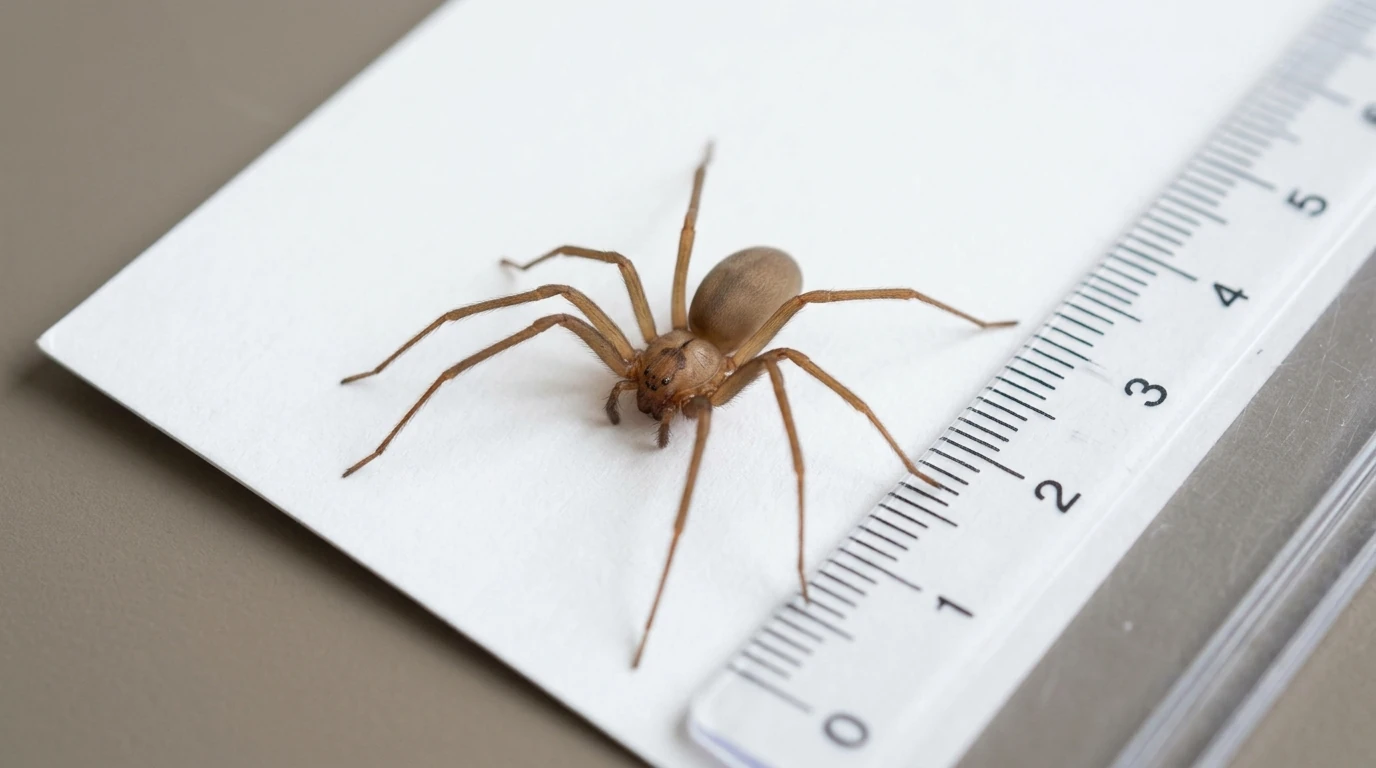
A brown recluse is one even tan-to-brown color with a darker violin shape on its back pointing toward the rear, has six eyes arranged in three pairs, and has plain legs with no bands, stripes or obvious spines. Its body is roughly the size of a pencil eraser to a dime. Spiders with striped or banded legs, patterned abdomens or eight eyes are not recluses. If yours matches every feature, keep it in a sealed jar or take a sharp photo and call.
The features that actually matter
The violin marking gets all the attention, but several harmless spiders have dark patches in the same place, so it should be the last check, not the first. The most reliable feature is the eyes: a brown recluse has six eyes arranged in three pairs in a shallow arc, where nearly every look-alike has eight. Phone cameras with a zoom lens can usually catch this if the spider is still.
Next, the legs. Recluse legs are uniformly colored and look smooth, without bands, rings or bristly spines. The abdomen is plain and evenly colored with fine short hairs, never striped, spotted or chevroned. Put together, the recluse is a strikingly plain spider, and pattern of any kind is a strong sign you have something else.
- Six eyes in three pairs
- One even color on body and legs
- No bands, stripes or spines on the legs
- Plain, unpatterned abdomen
- Dark violin shape behind the head, neck toward the rear
The usual look-alikes
Wolf spiders are the most common false alarm: larger, hairier, striped down the back, often running across basement floors in fall. Grass spiders and funnel weavers have striped bodies and build sheet webs in shrubs and window wells. Cellar spiders have long thin legs and tiny bodies. Ground spiders and sac spiders can be plain and pale, but their eye arrangement and leg proportions differ. All of these are harmless to people and eat other insects.
Where recluses actually turn up
Illinois public health guidance places the brown recluse in the southern third of the state, indoors and outdoors, and St. Clair County is inside that zone. Indoors they favor undisturbed storage: boxes in basements and closets, seldom-used shoes and clothing, attic clutter, the space behind furniture. They hunt at night and rarely build visible webs, so sightings tend to come from unpacking storage, putting on a shoe, or finding one in a bathtub it could not climb out of.
If it is a recluse
One confirmed recluse is a reason to place monitors, not to panic. Glue monitors along walls and behind stored items show within a couple of weeks whether you have a wanderer or a population. Meanwhile, shake out shoes and clothing that have been sitting, move beds a few inches off walls, keep bedding off the floor, and switch cardboard storage to sealed plastic totes as you can.
- Keep the specimen or a clear photo
- Shake out stored clothing and shoes before wearing
- Pull beds away from walls; keep bedding off the floor
- Wear gloves when digging through storage
- Call for identification and monitoring
When to call
Services that fit this problem
Before you call
Common follow-up questions
Most bites heal without serious trouble, and a minority cause a slow-healing wound that needs medical care. Anyone with a suspected bite should see a doctor, ideally bringing the spider.
Not necessarily. Monitors answer the question within a couple of weeks, and that is the honest first step.
Usually not with confidence. A still spider, good light and a zoomed shot of the head and legs give an answer in minutes.
Darlene Pemberton is the pest control guides editor at Belleville Pest Control. She writes and maintains these homeowner guides from the field notes our technicians bring back from jobs across Belleville and the Metro East, and every guide is checked against what the crews actually see in local homes.
Keep reading
Related homeowner guides
One call does it
Rather just ask someone?
Call and describe what you found. A technician will tell you what it is and whether it needs a visit.
(217) 207-0945Answered 24/7, every day