- Home
- Pest Guides
- A wasp nest in the soffit: what to do and what to skip
Insects & spiders
A wasp nest in the soffit: what to do and what to skip
A nest under the eaves is common and usually manageable, but the wrong move turns it into a bad afternoon. The type of wasp, where the nest sits and how big it has grown decide whether it is a quick job or one to leave to someone in a suit.
Call (217) 207-0945 Browse our services
- Written by Darlene Pemberton
- Updated October 1, 2026
- 5 minute read
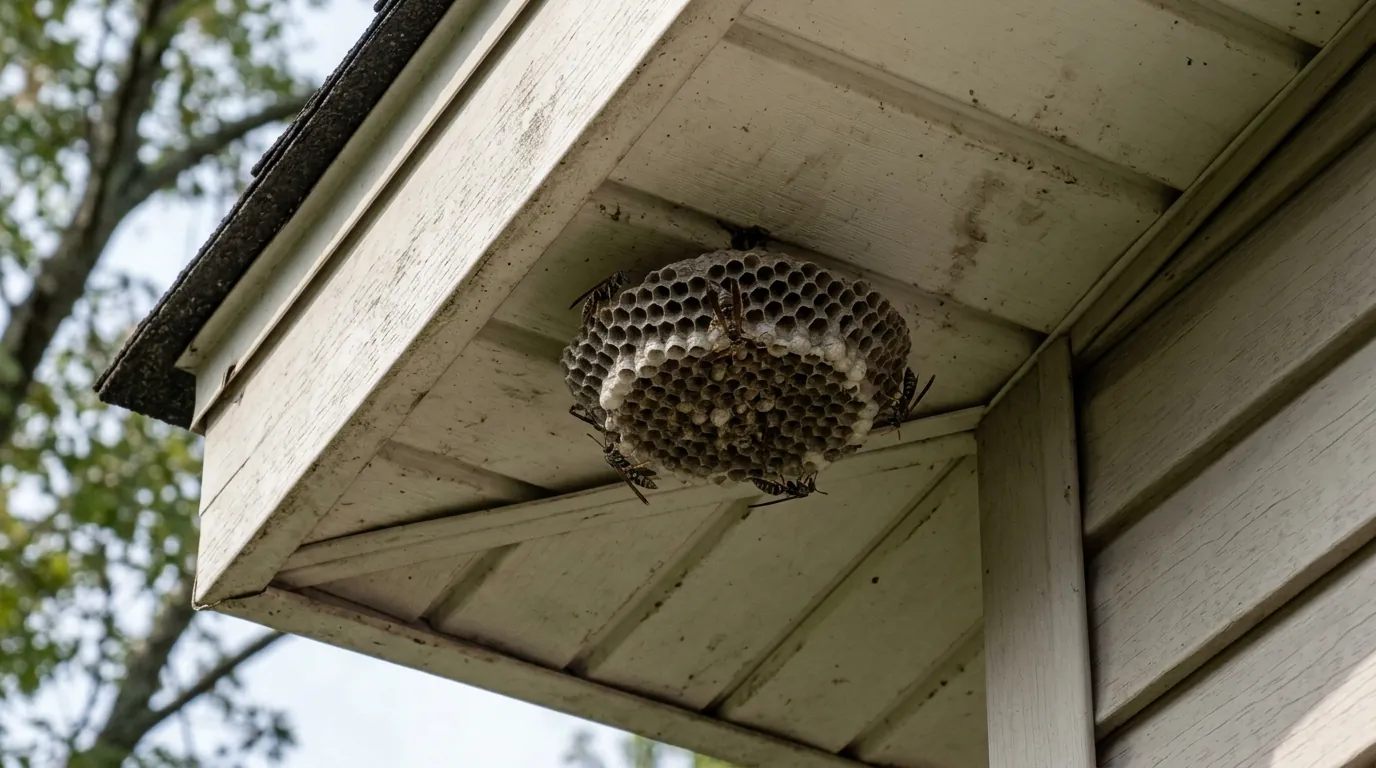
An open, umbrella-shaped nest of visible cells under the eaves is usually paper wasps, which are less aggressive and often manageable early in the season. A covered, papery nest or wasps disappearing into a gap in the soffit usually means yellow jackets, which defend hard and should be left to a professional. Never seal the gap they are using, never knock a nest down by hand, and keep people and pets away from the entry.
Identify the nest first
Paper wasps build open combs that hang from a short stalk, with the hexagonal cells visible from below. They are slender, with dangling legs in flight, and they tend to defend only when the nest is directly disturbed. Yellow jackets are stockier, brightly banded and fast, and they build enclosed paper nests, often hidden inside voids, with a single entrance hole. Bald-faced hornets, black and white, build large gray football-shaped nests in trees, shrubs and sometimes under eaves.
| Nest | Likely wasp | Risk level |
|---|---|---|
| Open comb, cells visible | Paper wasps | Moderate; defend when disturbed |
| Wasps entering a gap in the soffit | Yellow jackets | High; large hidden colonies |
| Gray football shape | Bald-faced hornets | High; defend a wide area |
| Mud tubes on brick | Mud daubers | Low; rarely sting |
Why sealing the hole is the classic mistake
When yellow jackets are flying in and out of a gap in the soffit or siding, the nest is inside the void. Plugging the gap does not kill the colony; it traps thousands of wasps who then chew toward the nearest light, which is often inside the house through a ceiling fixture or wall. Leave the entrance open until the colony is treated and has died off, then seal it.
Why timing matters
Wasp nests start small in spring with a single queen and grow all summer, peaking in late summer with hundreds or thousands of workers. A nest found in May is a quick job; the same nest in late August is bigger, more defensive and closer to the season when yellow jackets get aggressive around food and trash. Finding and handling nests early is the cheapest version of this problem.
What to skip
Do not swat at a nest with a broom, spray it from a ladder, use fire or try to flood it. Ladder work near an active nest is how stings turn into falls. Store sprays can work on small, low, open paper wasp nests early in the season, but they do not reach a nest inside a void and tend to stir up the colony.
- Do not seal an active entrance
- Do not knock the nest down by hand
- Do not work from a ladder near an active nest
- Do not use fire or water
- Keep kids and pets away from the entry
When to call right away
Call promptly if anyone in the household is allergic to stings, if the nest is beside a door, window or play area, if wasps are entering a gap in the structure, or if you see wasps inside the house repeatedly. Stinging insect calls get priority scheduling with us for exactly these reasons.
When to call
Services that fit this problem
Before you call
Common follow-up questions
The colony dies off with hard frost, and old nests are not reused, but a nest beside a door all summer is a risk worth handling sooner.
New queens often pick similar sheltered spots. Treating the area after removal and a spring check make repeat nests less likely.
They rarely sting. Their mud tubes can be scraped off once vacated, and they are usually more nuisance than threat.
Darlene Pemberton is the pest control guides editor at Belleville Pest Control. She writes and maintains these homeowner guides from the field notes our technicians bring back from jobs across Belleville and the Metro East, and every guide is checked against what the crews actually see in local homes.
Keep reading
Related homeowner guides
One call does it
Rather just ask someone?
Call and describe what you found. A technician will tell you what it is and whether it needs a visit.
(217) 207-0945Answered 24/7, every day